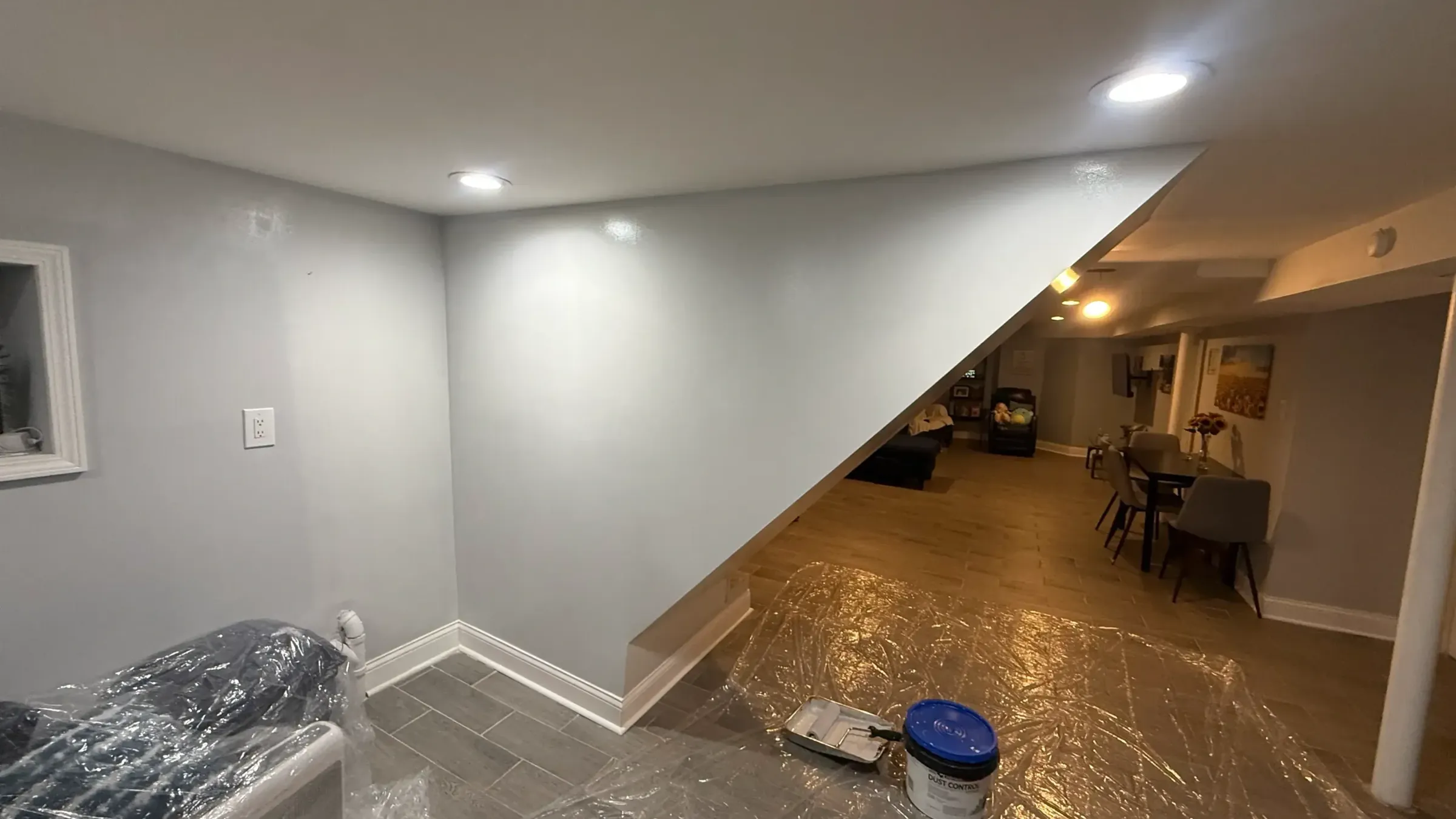
Drywall Installation in Chicago
New walls and ceilings for Chicago homes and condos, priced in writing before we start.
A burst pipe upstairs and a crumbling plaster ceiling tend to end the same way, with fresh gypsum board. Drywall installation in Chicago comes with its own fine print, from condo elevator bookings to permit thresholds. We're Chicago HB Drywall, a Chicago drywall contractor that does drywall and plaster and nothing else. Send a few photos and you'll have a written estimate before anyone shows up with a drill.
What We Install
Most drywall installation services we run fall into five jobs. Each one starts with picking the right board.
Wall and Ceiling Replacement
A ceiling that let go after the upstairs tub overflowed is drywall replacement in its purest form. We cut back to solid framing and hang new sheetrock, 1/2-inch board on most walls and 5/8-inch board on ceilings where the joists sit wide. Chicago's permit guide lets you swap up to 1,000 square feet of drywall or plaster without a permit, provided the wiring and pipes inside stay put. Our From $450 per-sheet price takes in the demolition, the new sheet, taping, mud and sanding. Primer and paint go on a separate line, the same as framing repair and insulation. A hole smaller than a sheet is cheaper as drywall repair.
Moisture-Resistant Drywall for Bathrooms and Kitchens
The ceiling over a tub is where steam does its damage, and the brown freckles up there are the first complaint. Green or purple moisture-resistant drywall puts up with it far longer for a few dollars more a sheet. Mold-resistant board earns its small upcharge in a bath where the fan sounds busy and moves no air. Inside a wet shower, tile goes on cement board, which water can't turn into mush.
Fire-Rated Drywall for Garages
Codes treat the wall between an attached garage and the house as a fire separation, since a car and a gas can live on the other side. Type X board gets glass fibers mixed into its gypsum core, which keeps the sheet in one piece longer once a fire starts. Replace part of a fire-rated assembly and the new garage wall sheet has to carry the same rating, so we check what the old wall was built with before we cut. We use fire-rated materials for these walls.
Drop Ceilings
Basements love a suspended ceiling, because the pipes and ducts stay one tile away. Drop ceiling installation starts From $12 per square foot for the ceiling grid and acoustic tiles. Swapping a worn drop ceiling for the same kind doesn't need a permit in Chicago, unless it belongs to a fire-rated assembly.
Sound-Reducing Walls Between Units
Condos and two-flats share walls, and your neighbor's TV shouldn't join you for dinner. We build soundproof drywall assemblies on request. Resilient channel and sound insulation in the stud bays are the usual tools, sometimes with a second layer of board on the party wall. We pick the mix for your wall. In a condo we follow the building's rules, and management gets a COI whenever it asks.
Installation Prices at a Glance
On a typical job the square footage sets the price, and a tall ceiling or a higher finish level nudges it up from there, as does special board. $6 a square foot is the starting point for a flat wall, with Level 5 adding $3 a square foot over that.
| Type of Work | Cost in Chicago |
|---|---|
| Drywall installation, per sq ft | From $6 |
| Drywall sheet replacement, per sheet | From $450 |
| Drop ceiling installation, per sq ft | From $12 |
| Level 5 finish, per sq ft, add-on | From $3 |
| Skim coating, per sq ft | From $4.50 |
| Emergency service | +$250 fee |
Our full price list covers repairs and plaster too.
New Walls, Basements and Attics: When a Permit Comes In
A homeowner replacing a moldy basement wall sheet for sheet stays under the city's 1,000-square-foot line and needs no permit. Framing a brand-new wall down there is another matter, and so is finishing an attic. The Chicago Express Permit for interior alterations covers nonstructural remodeling up to 2,000 square feet inside one home. When walls move or appear, drawings from an Illinois-licensed architect or structural engineer join the application, and that goes for an unheated attic turned bedroom as well. Landmark buildings and landmark districts can lose these exemptions. Wherever a permit applies, city rules hand the paid work to a licensed general contractor.
Finish Levels: How Smooth the Wall Ends Up
The drywall industry grades finishing from Level 0 to Level 5. Level 0 is bare board, screws showing. Levels 1 and 2 leave tape under a thin coat of compound, which is plenty for an attic or a wall getting tile. Level 3 suits heavy texture. A level 4 finish is the standard under flat or eggshell paint in most Chicago living rooms. A level 5 finish skims the entire surface, which sounds fussy until low sun from a bay window crosses a glossy wall and every seam shows up for dinner. That's where its From $3 per square foot add-on pays for itself.
How an Installation Job Runs
Every job follows the same order.
- You send photos and measurements.
- A written estimate comes back.
- Floors get covered, doorways get plastic.
- Drywall removal goes out bagged.
- Hanging comes next, drywall screws into studs and joists.
- Tape and corner bead go on with the first coat.
- Sanding runs with dust control on.
- Cleanup closes the day.
Sweeping and vacuuming the work area is part of the price, while bagging and hauling the old board gets its own estimate line, so you see exactly what disposal costs. The start date and the schedule get settled before anything comes off the wall.
Installing Drywall in Older Chicago Buildings
Ceilings in a 1925 two-flat dip between joists and the corners lean, since the plaster went up by hand long before laser levels, so furring strips come first. Loose plaster, or wiring you'd like to see, is a good reason for plaster removal, dust and all. Plaster that still grips the lath can take laminating over plaster with thin drywall instead, which is quicker. Our plaster repair page covers keeping it.
Before demolition in a pre-1978 home, lead paint may call for a city Lead-based Paint Renovation, Repair and Painting form, which the Department of Environment has handled since May 2026. Joint compound from before the late 1970s belongs in an asbestos test before anyone sands it. The city's page on lead and asbestos rules for renovation in Chicago lists the forms.
Frequently Asked Questions
What is the process for installing drywall?
You'll want the ceiling hung before the walls, then the long walls in 12-foot sheets so there are fewer butt joints, and the seams taped and coated three times.
When drywalling, do you tape or mud first?
If you're using paper tape, the mud goes on first as a bed for it, and you'll only reverse the order with self-adhesive mesh tape, which sticks to a dry seam.
What are two common mistakes made during drywalling?
You'll see overdriven screws that tear the face paper and lose their grip, and seams that never got feathered wide enough, which light from a west window picks out every evening.
When should drywall be replaced?
Board that has soaked through or grown mold gets replaced, and so does a sheet with damage across most of its face, while a dry leak stain only needs stain-blocking primer.
Can you replace drywall yourself?
You can, as long as you've got help for ceilings, since a 4x8 sheet of 1/2-inch board weighs around 50 pounds and a rented drywall lift saves your shoulders.
What can you replace drywall with?
Cement board is the standard behind shower tile, and plywood or wood paneling can stand in on a basement or garage wall as long as the fire rules for that wall allow it.
Photos from your phone and rough room sizes are enough to get an installation quote. The reply lands in about five minutes between 8am and 8pm, any day of the week, at (312) 485-7139.